
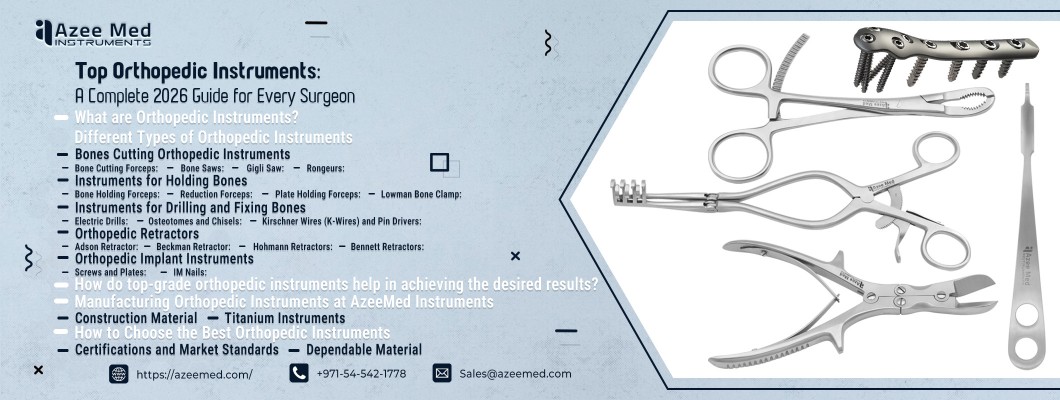
Orthopedic instruments help examine, analyse, and treat different conditions related to the musculoskeletal system. It should be noted that orthopedics includes highly impactful procedures. Therefore, most of the orthopedic instruments use stainless steel and titanium in their construction.
At AzeeMed Instruments, we believe in supplying highly qualified surgical instruments. Once you get your hands on our tools, you can navigate your surgical field without any worry.
In this complete 2026 guide, we will walk you through a detailed map on top orthopedic instruments every surgeon should know. Read on to explore!
What are Orthopedic Instruments?
Every orthopedic procedure requires the use of nails, drills, and screws, which must be properly handled with the help of specialised tools. Therefore, we have orthopedic instruments available for orthopedic procedures. During procedures like fracture repair and spinal surgery, surgeons use heavy-duty medical instruments to perform different functions. These functions include tightening the screws, cutting the bone, and drilling the holes, among others.
Different Types of Orthopedic Instruments
For your convenience, the orthopedic instruments have been categorised under separate functions. Given is a quick overview of different types of orthopedic instruments, precisely:
Bones Cutting Orthopedic Instruments
Practitioners rely on bone-cutting orthopedic tools to cut and drill. Here is a list of the following bone-cutting instruments, which you must know about:
Bone Cutting Forceps: Whether it is a fracture repair or a reconstruction, surgeons may require some plier-like tools. These tools help divide the bones into different pieces. Once divided, the parts can then be joined.
Bone Saws: These heavy-duty tools come with a zig-zag, sharp edge. Once administered, surgeons use these to notch controlled cuts.
Gigli Saw: These tacky tools help perform controlled incisions and divisions.
Rongeurs: With the help of these scoop-like tools, surgeons make windows and openings in a bone.
Instruments for Holding Bones
The orthopedic surgical field deals with muscles and bones. During the procedure, surgeons need to hold specific tissues. Therefore, this purpose is achieved with the help of specialised bone-holding instruments.
We have enlisted major bone-holding instruments below, such as:
Bone Holding Forceps: When surgeons are fitting the fractured bones in place, they use bone holding forceps. Mostly, the field uses Lane and Hey Groves forceps for the purpose of holding and manipulating.
Reduction Forceps: The misplaced bones during the procedure need to be brought back to their proper shape. At this critical point, surgeons use reduction forceps.
Plate Holding Forceps: Once the fractured bone has been properly fitted, surgeons use plate holding forceps to keep the plate static. Then they insert nails and screws, wherever required. Usually, this tool uses curved jaws to go well with the contours of the anatomical structures.
Lowman Bone Clamp: Reduction procedures use a curved, prong-like instrument for applying compression. This tool is known as the Lowman bone clamp.
Instruments for Drilling and Fixing Bones
Different orthopedic surgeries require drilling machines, pin drivers, and wires, etc. Here’s a brief round-up of major instruments, such as:
Electric Drills: No, not the mechanical drill different carpenters use. Orthopedic surgeons use electric drills to make holes in the bones. Once the drilling has been done, surgeons fix fractures by screwing nails and pegs, etc.
Osteotomes and Chisels: Every orthopedic surgery requires finishing tools. These tools help round up the rough edges. Osteotomes and chisels fall under this category. Moreover, they may also require osteotomes to graft bones for taking samples.
Kirschner Wires (K-Wires) and Pin Drivers: Mostly, temporary alignment is reached with the help of pin drivers and K-wires.
Orthopedic Retractors
Typically, health practitioners and orthopedics use retractors to push aside any bone or tissue coming in the way of manipulation. Here is a list of orthopedic retractors that can be useful to know:
Adson Retractor: These retractors work on heavy muscles to achieve a clear view of the surgical field.
Beckman Retractor: These self-retaining retractors allow surgeons to navigate the field without any worry of actively holding the instrument.
Hohmann Retractors: This retractor uses the hooking method to achieve an unobstructed view.
Bennett Retractors: Whenever surgeons need to push aside thick and deep tissues, they use these retractors.
Orthopedic Implant Instruments
The world of orthopedics is a repository of supplementary accessories. These accessories, known as the implants, help fix plates and screws. For fixing them on the plates, surgeons use orthopedic implant instruments, such as:
Screws and Plates: Screws act as binders to attach plates.
IM Nails: IM nails assist in fixing different types of fractures.
How do top-grade orthopedic instruments help in achieving the desired results?
Here’s how having top-grade orthopedic surgical tools can ensure successful surgical procedures:
If you have orthopedic instruments made of top-grade surgical stainless steel (304 or 316), you will have your tools for a lifetime. However, it is important to follow the instructions and protocols.
Certified surgical tools seldom break. Any tool breakage during the surgery can be exhausting. Therefore, always get your hands on premium surgical tools.
High-quality orthopedic instruments undergo various quality assessment tests before shipping. Therefore, screws and locks are always in their right position for optimum results.
Manufacturing Orthopedic Instruments at AzeeMed Instruments
Construction Material
At AzeeMed Instruments, our highly qualified professionals make sure to use the top-quality German surgical stainless steel. With top-notch material, complications diminish, creating a healthy post-op environment.
Titanium Instruments
Usually, when it comes to orthopedics, we use titanium for implants, screws, plates, and drivers. This material can survive any force or impact. Furthermore, it is biocompatible, making it safe for use in the human body.
How to Choose the Best Orthopedic Instruments
Here’s a brief list of all the points you need to consider before choosing orthopedic instruments:
Certifications and Market Standards
You can ensure quality and standard by looking for CE and FDA certifications of your surgical supply store. Moreover, see if the tools are ASTM F899-compliant 440C or 420 stainless steel compliant. Lastly, make sure the supply store is ISO-certified.
Dependable Material
Orthopedics can be challenging. Therefore, make sure you tick all the certification boxes before buying. Only then will you be able to enjoy perfectly durable orthopedic instruments in your working surgical field.
FAQs
Q1: What makes our orthopedic instruments have a long life?
You can ensure the longevity of instruments of orthopedic surgery by following cleaning protocols and storage techniques. Lastly, proper storage always helps you master the art of orthopedics, as this helps keep the heavy-duty instruments safe.
Q2: Which orthopedic instruments should be present in an orthopedic field?
Instruments for bone cutting, drilling, fixing, retracting, and implanting should be present in an orthopedic field.
Final Thoughts on Orthopedic Instruments
In a world where surgical trends change with each passing minute, staying up-to-date is important. In this complete 2026 guide for every surgeon, we have opened up our extensive collection of orthopedic instruments for your ease.
From different types of orthopedic tools to maintenance tips, we have covered all. In case you are looking for a reliable surgical facility, contact us now!
22 Comment(s)
This post is really well-researched, and it's clear that you worked hard to compile the data. I'm looking forward to reading more of your writing.
What a great article! I found myself nodding along as I read it because I absolutely agree with your main points. Seeing content that is both educational and actually beneficial is refreshing. Anticipating your upcoming post!
I understand your point of view and appreciate the work that went into this post. Nevertheless, I believe there is another aspect of this that is worthwhile. If you ever think about this topic again, I'd love to hear what you think.
Neat blog! Is your theme custom made or did you download it
from somewhere? A theme like yours with a few simple tweeks would
really make my blog shine. Please let me know where you got your design. Kudos
tele4
I love what you guys are up too. This kind of clever
work and coverage! Keep up the fantastic works guys I've added you guys
to blogroll.
This is really interesting, You're an excessively skilled blogger.
I have joined your rss feed and sit up for looking for extra of your wonderful post.
Also, I have shared your web site in my social networks
Hi, I think your blog might be having browser compatibility issues.
When I look at your blog site in Firefox, it looks fine but when opening in Internet
Explorer, it has some overlapping. I just wanted to give you a
quick heads up! Other then that, excellent blog!
No matter if some one searches for his required thing, therefore he/she needs to be available that in detail, so that thing is maintained
over here.
Hello, i think that i saw you visited my blog so i came to “return the favor”.I'm attempting to find
things to enhance my website!I suppose its ok to use a few of your ideas!!
Thanks for sharing your thoughts about Top Orthopedic Instruments.
Regards
I think this is among the most significant info for me.
And i'm glad reading your article. But want to remark on some general things,
The website style is perfect, the articles is really nice
: D. Good job, cheers
Having read this I believed it was extremely enlightening.
I appreciate you taking the time and energy to put this information together.
I once again find myself spending way too much time both reading and leaving comments.
But so what, it was still worth it!
Each product offered by Specdobavki is accompanied by essential
certificates and declarations that ensure both the safety
and high quality of the items. spec dobavki.
I all the time used to study post in news papers but now as I am a user of web
so from now I am using net for articles or reviews, thanks to web.
If you want to get a great deal from this paragraph then you have to apply such strategies to
your won weblog.
Heya i am for the first time here. I found this board and I
find It really useful & it helped me out much.
I hope to give something back and aid others
like you aided me.
Hi there! This is my first comment here so I just wanted to give a quick shout
out and say I truly enjoy reading through your blog posts. Can you suggest any other
blogs/websites/forums that deal with the same subjects? Thanks
a lot!
I am really enjoying the theme/design of your site. Do you ever run into any
internet browser compatibility problems? A handful of my blog
visitors have complained about my site not operating correctly in Explorer but looks great in Firefox.
Do you have any recommendations to help fix this problem?
What's up mates, good article and fastidious arguments commented at
this place, I am in fact enjoying by these.
Hi there, this weekend is good designed for me, because this point in time i am reading this great informative post here at my residence.
I'm impressed, I have to admit. Seldom do I encounter a blog that's both educative and entertaining, and let me
tell you, you've hit the nail on the head. The issue is an issue that
too few people are speaking intelligently about.
I'm very happy I found this during my hunt for something concerning this.
Leave a Comment