
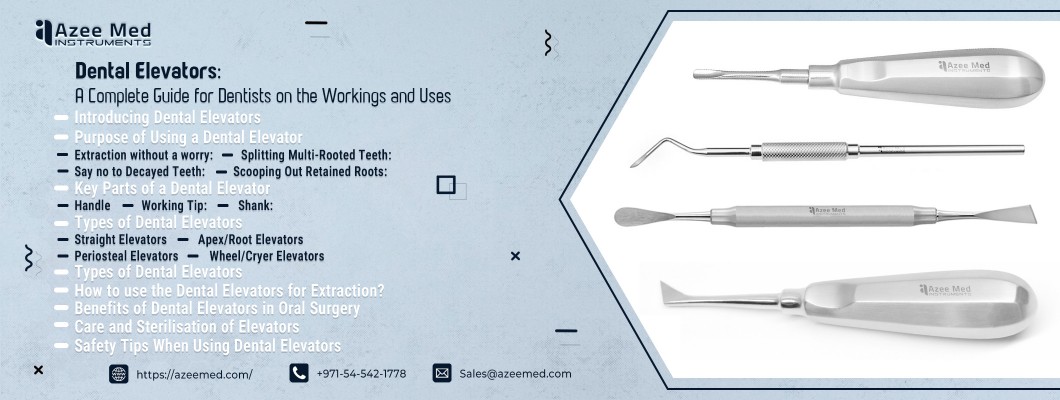
Dental elevators function as specialised tools that help loosen the teeth from the gums. Once loosened, the teeth can then be extracted. Typically, the elevators work on the principle of wedging, torque, and leverage. These techniques can scoop out the teeth from the socket without any extra hassle.
AzeeMed Instruments has been known for its remarkable contributions in the field of dentistry. In this complete guide, we have covered the importance, uses, and functions of dental elevators for dentists. Continue reading to explore!
Introducing Dental Elevators
A dental elevator is a part and parcel of dental extraction procedures. During the extraction procedure, dental surgeons use dental elevators to lift the teeth from the socket after incising the periodontal ligament.
First and foremost, dental elevators create a lifting force. Secondly, they insert their blade between the teeth and the bone. This helps loosen and create a space. Finally, the dentist pulls at it, rotates the elevator, and the tooth pops out.
Purpose of Using a Dental Elevator
Here, we have summed up the purpose of using a dental elevator. Note:
Extraction without a worry: The dental elevator works as a lever. It helps create space between the gums and the tooth. Once the space is created, the tooth can be removed.
Splitting Multi-Rooted Teeth: Sometimes, surgeons can use dental elevators to split multi-rooted teeth.
Say no to Decayed Teeth: Decayed teeth can be stubborn. Therefore, dentists use dental elevators to remove them from the gums for good.
Scooping Out Retained Roots: At times, during extraction, the root can chip off, staying in the socket. Once this happens, dental elevators come to the rescue.
Key Parts of a Dental Elevator
Typically, a dental elevator comprises three major components. Here’s how knowing about these parts is important to get the most out of the tool:
Handle: Most dental elevators feature a proper handle. This handle comes with a placement spot. Once the dentist holds the tool at this spot, it becomes easy for them to control the movements. Moreover, the tool can come with a slight angle. This helps maximise torque.
Working Tip: Depending on the need, the working tip can be flat, concave, or pointed. Usually, the type governs the angle from which the ligament has to be cut.
Shank: This is the middle section of a dental elevator. At this point, the handle comes in contact with the blade. At times, the shank can observe an angle. This helps access the specific areas of the mouth.
Types of Dental Elevators
Get ready to study the different types of dental elevators. Knowing these types can help decide the perfect dental elevator for your practice:
Straight Elevators
Dental extraction has now been made easy with the help of the most convenient dental elevator, known as the straight elevator. Usually, the tooth that has been intended for extraction comes under pressure when the elevator presses on the space between the tooth and the bone.
This step loosens up the tooth from the socket. At this point, dentists use dental forceps to remove the extracted tooth. Furthermore, surgeons use these elevators in their routine checkups too. The most common examples include the Coupland Elevator and the Warwick James Straight Elevator.
Apex/Root Elevators
When the tooth gets fractured, the broken piece of the tooth can remain embedded in the gum. It should be noted that this can cause infection. Therefore, an apex elevator comes to the rescue.
An apex elevator works on the root to remove the broken pieces of the tooth. Usually, the instrument comes in a narrow formation. The most common examples include the Crane Pick elevator and the Heidbrink root tip elevator.
Periosteal Elevators
There may be a need for retracting soft tissue. For this purpose, periosteal elevators are used. They help separated periosteum from the bony structure. Usually, flap elevation procedures and oral surgeries make use of periosteal elevators. Prichard Periosteal Elevator and Molt Periosteal Elevator are some of their types.
Wheel/Cryer Elevators
The dental surgeons working with bony fragments take the help of wheel elevators. Structurally, they have a triangular tip constructed at a slight angle. Therefore, they may come in handy during molar extractions. Lastly, they are a big savior for extracting teeth from deeper cavities. East-West and Cryer elevators are known as some of the most common Cryer elevators.
How to use the Dental Elevators for Extraction?
The first step involves the use of sharp luxators. These help detach the ligaments from the fiber. Resultantly, the supporting system of a tooth vanishes.
The second step sees the surgeons resting the tool on the nearby tissue. Once this happens, pressure is created, helping to take out the tooth from the socket.
Following this, the third step is just the force applied for extraction.
When the surgeons get the green signal, dental elevators then scoop out the tooth, and it is finally extracted.
Benefits of Dental Elevators in Oral Surgery
During oral surgeries, the dental elevators contribute in the following ways, precisely:
Trauma Reduction: Without the dental elevators, the surgeons may never know how much pressure to apply. More than necessary pressure can result in a bone fracture. Therefore, a dental elevator helps manage the amount of pressure.
Helps Section Roots: The use of dental elevators can help section stubborn roots. Once the elevator works on the root, it detaches and loosens for extraction.
Makes Complex Extractions Easy: Impacted teeth and retained roots can be hard to remove. Usually, teeth elevators come to help the practitioners in such cases.
Care and Sterilisation of Elevators
Oral hygiene plays a huge role in determining the overall health of the patient. Therefore, keeping your dental elevators always in their right shape and form is important. To clean, the used dental elevators follow a step-by-step protocol: rinsing, autoclaving, and sterilisation. After sterilisation, the tool can be kept in a kit for future use.
Safety Tips When Using Dental Elevators
Here’s all you need to know when it comes to using the dental elevators safely. You must:
Securely grasp the shank with your index finger.
Use a bony fulcrum to avoid any discomfort.
Adopt a levering motion along the long axis. In this way, the soft gums remain protected.
Choose the tip according to the tooth size.
FAQs
Q1: How is a luxator different from an elevator?
Where elevators help lift the dead tooth from the socket, the luxator works to sever the periodontal ligament. Due to their respective functions, the former comes in a heavy-built, while the latter is lighter in construction.
Q2: What is the best way of holding a dental elevator?
Usually, the surgeons are instructed to hold the handle of the dental elevator in their palm. The index finger usually goes on the shank. The other hand should be actively involved in elevating the tooth.
Final Thoughts on AzeeMed Instrument’s Tooth Extraction Elevators
No matter the demands of your surgical field, having the right surgical instrument can drastically improve the surgical outcome. In the ever-challenging surgical field of dentistry, the dental elevator has played the role of an unsung hero. Whether it is a straight elevator or a Root elevator, every configuration and style contributes to lifting the tooth from the socket, helping in extraction. To order, contact us now. The orders will be by your doorstep in 7-10 business days!
3 Comment(s)
I'm really happy to have found this post because I've been having trouble with this problem for a while. You've provided some really helpful advice and direction, and I like how you've divided the issue into smaller, more manageable chunks. I feel more confident and empowered to take on this challenge because of the workable and realistic solutions you've offered. We appreciate you sharing your knowledge and experience with us; it has really helped.
Pretty! This was an extremely wonderful article. Many thanks for providing this
info.
This is a fantastic article, and I love the way you've presented the information in a clear and concise manner. You've provided some really useful examples to support your arguments, and I like how you've divided difficult ideas into smaller, more digestible chunks. Reading this has taught me a lot, and I can't wait to implement some of the ideas you've covered in my own life. I truly appreciate you taking the time to write this. Thank you.
Leave a Comment