
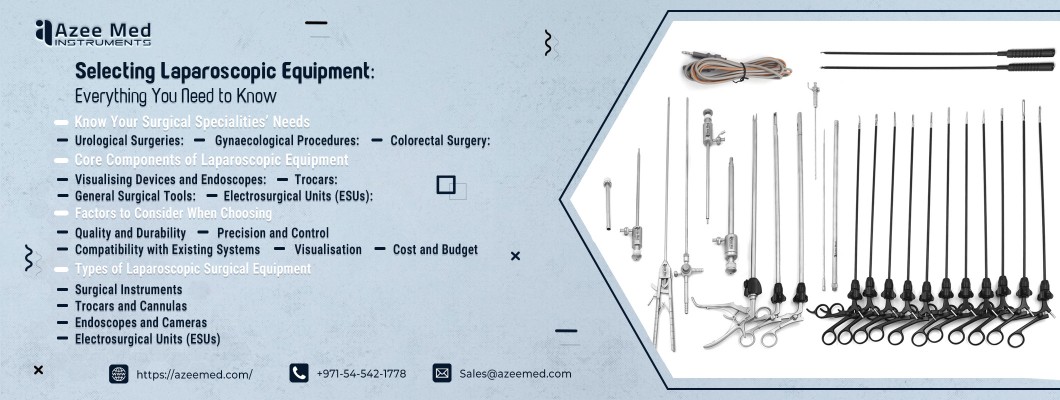
Laparoscopic equipment works wonders for modern keyhole surgery. Recently, the world of surgery came across a procedure known as the Laparoscopy. Typically, it is a minimally invasive surgical technique using a light source and a thin camera to visualise and diagnose the condition. AzeeMed Instruments believes in supplying professionals with top-grade surgical instruments. Therefore, we have an entire category dedicated to this modernised equipment for your convenience.
This article will help you with tips on selecting laparoscopic equipment. Moreover, we will cover everything you need to know about these tools, such as the core components and its types. Continue reading to explore!
Know Your Surgical Specialities’ Needs
Although commonly known, the laparoscopic surgery is not a particular, defined procedure. It is an umbrella term which has different types under it. For example, for general surgery, you would use one type of laparoscopic surgery. And for a gynaecological procedure, you would require a different type of laparoscopic procedure. Therefore, knowing the demands and needs of your surgical demand is important. We have briefly described each domain’s particular needs, such as:
Urological Surgeries: Urological surgeries use HD laparoscopic equipment. This enables the health professionals to take clear and detailed pictures of sites like the ureters, urethra, kidneys, and the urinary bladder.
Gynaecological Procedures: The surgical domain of gynaecology performs procedures like tubal ligation, ovarian cyst removal, etc. For these procedures, the laparoscopic equipment involved should be easily manoeuvrable.
Colorectal Surgery: Professionals use advanced imaging and laparoscopic tools for colorectal surgeries. Furthermore, the colorectal surgical sites can be deeper. Therefore, laparoscopes, which have deep access to the site,e are generally preferred.
Therefore, every surgeon needs to be sure of their specific needs and requirements.
Core Components of Laparoscopic Equipment
Here’s a quick round-up of the core components of laparoscopic equipment, which are absolutely required during the procedure. For example:
Visualising Devices and Endoscopes: For detailed diagnosis, surgeons require detailed pictures of the surgical site. Therefore, for this purpose, they use a high-definition camera. Mostly, endoscopes are used. They come with a light source to illuminate the deep surgical fields.
Trocars: Typically, every laparoscopic surgery begins by notching an incision, which acts as the point of entry. Trocars are specialised tools which help professionals with notching an incision.
General Surgical Tools: During different laparoscopic surgical procedures, surgeons also use general surgical tools and supplies, such as clamps and scissors, among others.
Electrosurgical Units (ESUs): Typically, electrosurgical units help coagulate and dissect. However, it is important to check the compatibility of your ESUs with the existing electronics.
Factors to Consider When Choosing
Usually, practitioners consider multiple factors before deciding on the type of laparoscopic equipment. Sometimes, the decisions are taken on personal preferences. At times, there may be a specific need of the time. However, the given factors are absolutely important when choosing, precisely:
Quality and Durability
If you want to keep your surgical site safe from any tool malfunction, order laparoscopic equipment which is top-grade and durable. Additionally, it is very important for maximising patient safety. It is often said that surgical instruments of low quality wear out earlier. Therefore, always get laparoscopic equipment of high-quality from certified stores like AzeeMed Instruments.
Precision and Control
Usually, precise laparoscopic surgical instruments provide maximum control during the procedure. Furthermore, surgeons prefer having tools with handles made of high-grade surgical steel with require prerequisites. Also, tools with a high strength-to-weight ratio perform well, as are available at our manufacturing unit.
Compatibility with Existing Systems
Professionals should do their research before purchasing laparoscopic instruments online. These systems and their setups differ in their software and working principles. Therefore, it is advisable to check the mutual compatibility of the existing systems with the new tools. In case of online shopping, taking a briefing from the support group can help minimise the chances of incompatibility.
Visualisation
Visualisation is defined by three different factors: Camera Resolution, Light Source, and Monitor Size and Placement. First and foremost, the Camera resolution should be high for high-quality images of the surgical site. Secondly, the LED light source should be brought into action. This helps surgeons stream the light over the site without any discontinuity. Lastly, the monitor should be placed in an accessible position for the surgeons to see.
Cost and Budget
Although efficient laparoscopic equipment performs well, it can be a little heavy on the pocket. Therefore, practitioners should do their research before purchasing. Usually, factors such as maintenance costs and replacement issues should be taken into account. Our manufacturing facility understands this problem and solves it by offering budget-friendly prices.
Types of Laparoscopic Surgical Equipment
Below is a brief introduction to major types of laparoscopic surgical equipment which the surgeons can’t live without, such as:
Surgical Instruments
Even during laparoscopic surgical procedures, the field sees the use of general surgical instruments. These tools include staplers, forceps, graspers, and electrosurgical instruments. Forceps help to hold organs and tissues. While staplers work to precisely place the sutures. Surgeons also use electrosurgical instruments, both mono and bipolar, which help in performing cauterisation.
Trocars and Cannulas
Usually, the laparoscopic surgical field features two different types of trocars: bladeless and visual trocars. The former works well for delicate surgical sites, where they work to reduce tissue trauma. The latter performs the function of visualisation of the abdominal cavity.
Endoscopes and Cameras
Majorly, two different types of endoscopes are available. They can either be rigid or flexible. The former helps picturise the easily accessible surgical sites. While the latter facilitates sites where manoeuvrability is needed.
Electrosurgical Units (ESUs)
Practitioners employ ESUs to access, cauterise, and coagulate.
FAQs
Q1: What to keep in mind while ordering laparoscopic equipment?
It is a common mistake that technicians forget to consider the compatibility of the laparoscopic equipment with the existing systems. Totally occupied by the thought of prices, they entirely ignore the compatibility factor. This, although seemingly small, can lead to major loss. Therefore, always see for the company, configuration and system compatibility. Also, check for online stores which offer replacement and repair policies.
Q2: How to avoid the chances of getting an infection while using laparoscopic equipment?
Steam sterilisation helps avoid any chances of infection. Furthermore, look for any development of scratches or tool malfunctions. These crevices often work as places for the bacteria to grow. Therefore, keep your surgical tools well-buffed and clean the hinges and locks properly.
Modernise Your Surgical Field with AzeeMed’s Top Collection of Laparoscopic Equipment
It is a fact that the right laparoscopic equipment can change the surgical game for good. Our high-quality laparoscopic surgical instruments can take away your worries regarding the development of any complications. Therefore, keep a check by assessing your needs and specific requirements to get the best of the laparoscopic surgical world. We have reviewed the core components, major types, and factors to consider while purchasing the laparoscopic instruments. If you are looking for surgical-grade stainless steel laparoscopic equipment, get in touch now. We supply certified and approved surgical instruments all over the globe.
6 Comment(s)
While looking for advice, I came across this blog, and I'm very happy that I did. Both the content and your writing style are excellent. I forwarded this to a few friends who I know will also find it useful. Outstanding work!
My perspective on the matter has changed as a result of this post. I like that you went into enough detail to make the conversation meaningful rather than concentrating only on broad concepts. I found this article very helpful and surprisingly relatable.
Awesome blog! Do you have any hints for aspiring writers? I'm hoping to start my own site soon but I'm a little lost on everything. Would you suggest starting with a free platform like Wordpress or go for a paid option? There are so many options out there that I'm completely confused .. Any suggestions? Appreciate it!
Nice blog here! Also your website loads up fast! What web host are
you using? Can I get your affiliate link to your host?
I wish my website loaded up as quickly as yours lol
Overall, it's a really well-written and easy-to-follow post. Starting this week, I'll try putting some of these suggestions into practice and see how it goes. If you have the time, I would love to see a follow-up post with more detailed examples.
You make such a difficult subject seem approachable with your writing style. Almost all of the paragraphs had me nodding along. I'm grateful that you took the time to produce something so valuable.
Leave a Comment